
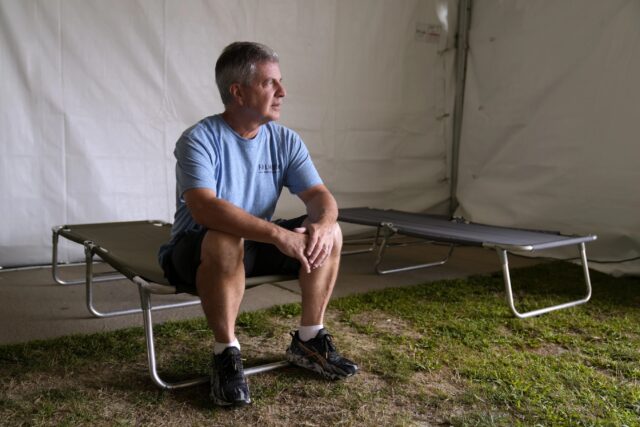
Dr. John Jardine Celebrates 25 Years as the Medical Director of The Falmouth Road Race
FALMOUTH, Mass. — The Falmouth Road Race is pleased to be celebrating Dr. John Jardine’s 25 years as Medical Director. Under his dedicated leadership, a medical team of around 250 volunteers and professionals have treated thousands of medical cases, nearly 500 cases of life-threatening exertional heat stroke, and ensured 25 consecutive safe and fatality-free race days.
Dr. Jardine’s multiple decades-long tenure as Medical Director started in the early 2000s. After attending medical school in New York, he completed his residency in Providence, Rhode Island, where he met his wife. The two of them moved to Falmouth, and his career launched from the Emergency Department (ED) at Falmouth Hospital in 2000.
His supervisor at the time encouraged him to volunteer at the race with the medical team at Mariner’s Point, where he served under the trusted direction of Regina Reed – the Medical Volunteer of the Year in 2023. “One of my Falmouth ED colleagues was a year ahead of me in my residency,” explains Jardine. “So in 2001, he volunteered the two of us to be medical directors.” He and Dr. Robert Davis, the former Chief of Emergency Medicine at Falmouth Hospital, served as co-directors for over a decade until Dr. Davis retired from the race in 2018.
“For the last 10 years I’ve been working with Chris Troyanos,” continues Jardine. “Chris is such a great asset – he gets the volunteers in place and has all the equipment ready each race day.” Troyanos serves as the Medical Program Coordinator and works in tandem with Dr. Jardine to ensure a smooth and safe race day.
Also worth noting is Dr. Jardine’s continued collaboration with the Korey Stringer Institute (KSI) to advance the field of event medicine. “Around 2007, I met Doug Casa from The University of Connecticut who started bringing his athletic training students [to Falmouth] to learn about exertional heat illnesses,” says Jardine. “It became known as Korey Stringer Institute in 2010, named after a Minnesota Vikings player who died of heat stroke.”
In 2014, Dr. Jardine was appointed the Chief Medical Officer of KSI, a position he’s held since; “There’s been a lot of opportunity for research because of the race.” With a team of around 250 volunteers stationed throughout the course, “We’ve taken care of thousands of medical cases over the 25 years I’ve been there,” shares Jardine. “We’ve had our share of emergencies but one of the things we see is life-threatening Exertional Heat Stroke. There could have been some bad outcomes and possible fatalities if not for the prompt medical care guided by our research.”
Exertional Heat Stroke (EHS) is a severe medical emergency characterized by dangerously high body temperatures and central nervous system dysfunction due to strenuous physical activity in hot conditions. Being a challenging road race in the heat of August, race day conditions can result in EHS if runners aren’t following Dr. Jardine’s tips – to stay well-hydrated, to run wisely, and to listen to their bodies for signs to slow down.
KSI has been partnering with the race to study heat stroke and publish research articles over the past decade – since discovering that the best treatment is cold water immersion. The medical tents come prepared with tubs for ice baths for that very reason, and “we see 90% of our patients going home from the tent” thanks to the dedication of the volunteer team.
“It’s a great team effort and I think last year around 60% of the medical volunteers were first-timers,” says Jardine. “It’s so fun to watch our volunteers learning. We welcome physicians, nurses, physical therapists, EMTs, and people who have no medical training at all. We have all levels of training and we welcome everyone who is interested in race medicine.”
One of the returning volunteers is his daughter, who was born in Falmouth. “She started volunteering with me at the race when she was young and is now, at 24, an EMT like I was,” says Jardine. “I love having her right there with me, and it’s fun for her to help out and be a part of it all.”
He has watched many families grow up with the race, just like his own. “When I started this race it was run by two families, the Carrolls and the Shermans, and it’s been amazing to see what they developed and what it’s turned into.” Starting from a small team, he has witnessed the race’s evolution over the past 25 years to an event that educates a medical team in the two hundreds and informs essential medical research.
“In the medical community the amount of research we’ve done is very important,” expresses Jardine. “It’s a rewarding thing to keep paying it forward to these new volunteers and researchers and passing it on to future generations. I plan to keep doing this as long as I can.”