Pioneer (noun): A person … that originates or helps open up a new line of thought or activity or a new method or technical development. Source: merriam-webster.com/dictionary
Bob Hall’s intentions more than 50 years ago were never to be a trailblazer. He simply wanted to be an athlete who competed and pushed beyond so-called limitations, striving always for success.
He did that, for sure, becoming the best in his sport through an indomitable will and strength of spirit. All along the way, however, Hall did even more, leaving a legacy that endures beyond the cheers he often heard as a wheelchair champion.
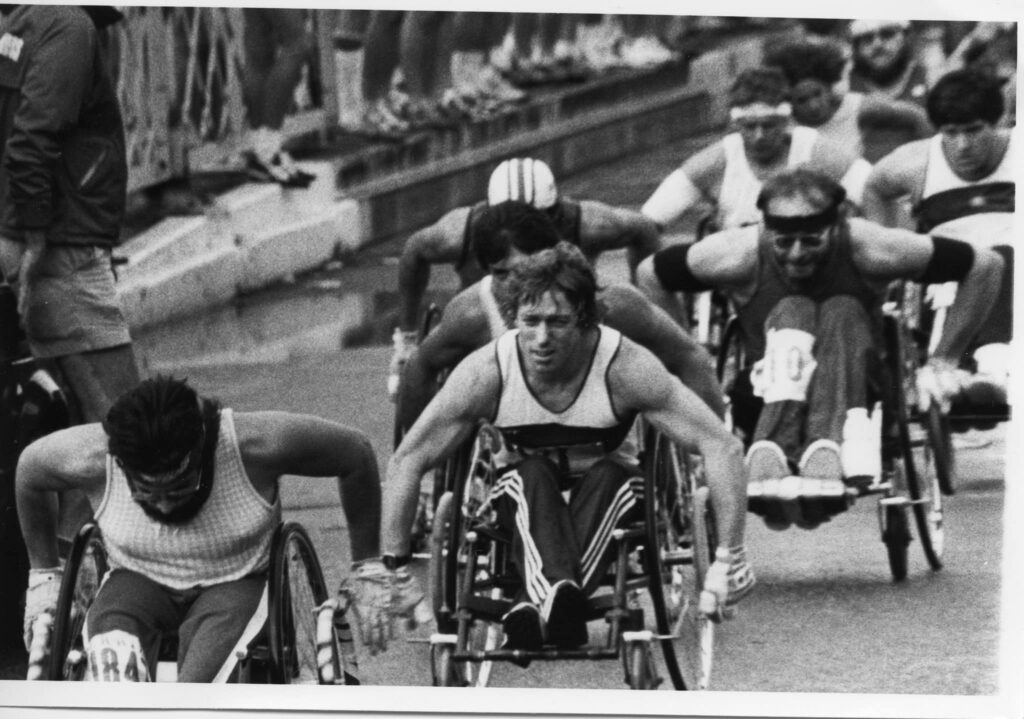
Bob Hall (middle) in a group of racers in the 1981 Falmouth Road Race
The 53rd renewal of the ASICS Falmouth Road Race on Aug. 17 will mark the 50th year of wheelchair racing over the roads from Woods Hole to Falmouth Heights. Hall pushed open the door in 1975 and many more have since rolled though.
Defending Falmouth champions Miguel Jimenez-Vergara of San Diego and Hoda Elshorbagy of Egypt, who trains in Illinois, are scheduled to return, along with a host of past winners. In all, about 30 competitors are expected at the Tommy Leonard Start Line, making it one of the largest fields in race history.
The 50th wheelchair division is presented by Compassionate Care ALS (CCALS), a Cape Cod-based non-profit organization with a mission to assist people physically, emotionally, and spiritually as they navigate the complexities of living with Amyotrophic Lateral Sclerosis (ALS).
“The wheelchair race is something very near to our heart since people with ALS are eventually dependent upon wheelchairs,” said Ron Hoffman, founder and executive director. “I’ve always had a soft spot for the folks who are in the competitive wheelchair race because of the dedication and spirit in how they have learned to live their life in a different way, which is what I share with our ALS families.”
The wheelchair division will also celebrate Hall, a pioneer who broke down barriers and created access for future generations of athletes to shine on sport’s grandest stages, including Falmouth.
Hall was Falmouth’s first (and only) wheelchair racer in 1975, just a few months after he completed the Boston Marathon in under three hours, a stipulation he had to meet to earn a finisher certificate and his accomplishment to be recognized.
Hall then set his sights on Falmouth later that summer. With support from his friend and Greater Boston Track Club teammate Bill Rodgers, he was welcomed with no such conditions from the race directors.
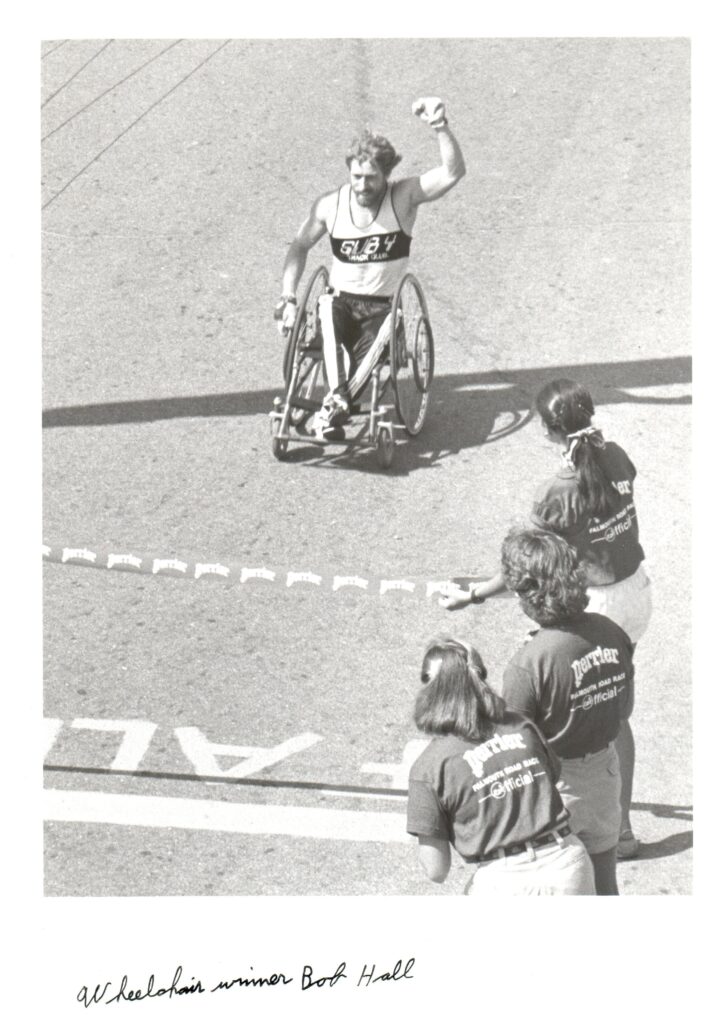
Co-directors Rich and Kathy Sherman, along with John and Lucia Carroll, embraced Hall’s entry. Kathy Sherman, a special needs teacher in the Falmouth school system, was particularly excited. Hall said it was the first time he was in a road race as a registered competitor and received a bib number as an official entrant.
“I started in the front,” Hall said of that August Sunday 50 years ago. “I just lined up where I thought was best for everybody. In Boston, I was in the back. I didn’t want to be a sensation. I didn’t want to cause a problem. I just wanted to compete.”
That was all that Hall ever wanted, to be accepted and treated as an athlete, nothing more. In turn, ever since Falmouth has been a leader for creating opportunities for adaptive athletes.
When Hall was denied entry into the 1977 New York City Marathon, Falmouth came to his aid. Hall took legal action against the marathon’s organizers and Rich Sherman, as a Falmouth director, gave a deposition in the court case supporting Hall’s athletic credentials and long-distance racing ability. Hall won and competed in the five-borough race.
“Falmouth was the first (nonmarathon) road race in America to have a wheelchair division and the sport has evolved and spread across the world since that first race in 1975,” said Matt Manchester, the event’s Adaptive Athletes Program Manager. “Falmouth has had a great history of inclusivity and being at the forefront of adapting and being open to various new ideas.”
Hoffman is proud to have CCALS be part of the race.
“The whole idea of accessibility is so incredibly important to us at CCALS, and I’m incredibly grateful to have the opportunity to expand awareness, not just about us as an organization, but about all those living with ALS and other disabilities,” said Hoffman.
Hermin Garic, the 2021 champion, has many fond memories of racing in Falmouth.
“There are so many things I remember, like that last stretch and the hill, sprinting toward a podium finish, or a win,” said Garic. “The American flag (at the finish), and the thousands of fans, it’s hard to describe. They have to be some of the most exhilarating things I’ve done in wheelchair racing. You just have to experience it and be part of it all.
“It’s one of those community events where I feel like I’m returning to my Falmouth family,” said Garic. “Matt (Manchester) treats us like superstars. Winning the race was special – but not as special as all the memories I’ve created and the friends I’ve made over the years.”Craig Blanchette, an eight-time champion, is equally appreciative of the camaraderie and atmosphere on race weekend.
“Falmouth has grown, but has kept its soul and that’s beautiful,” said Blanchette. “They always have treated us as elites and I’m grateful to be part of the history.”
Manchester, now in his ninth year coordinating the division, is supported by many loyal volunteers, including Johnny Netto, who is instrumental in handling much of the logistics of transporting the athletes’ racing chairs to the starting line. David and Nancy Serbun have also made important contributions for many years as a host family for adaptive athletes, including two-time champion Jill (Moore) White.
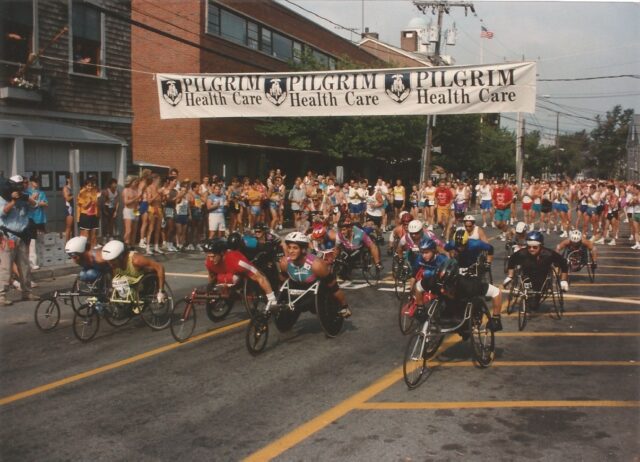
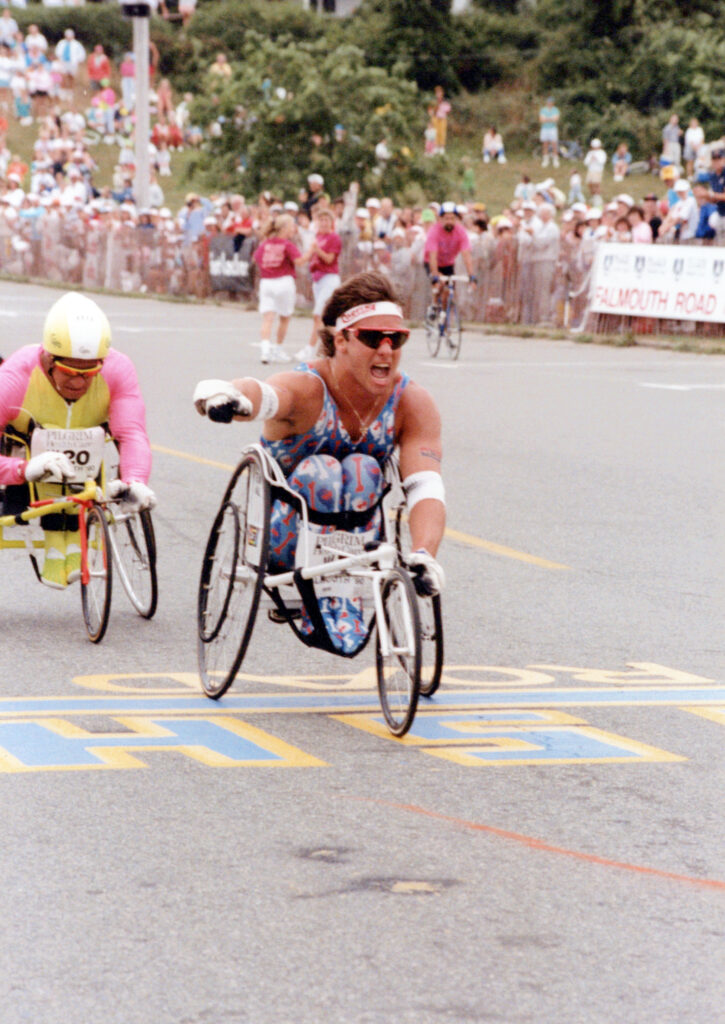
Photo: Louis Antonio crossing the finish line just ahead of Rafael Ibarra in the 1990 Falmouth Road Race
Falmouth at the forefront of the sport
Hall, now 74, who lives in Watertown, contracted polio in 1952 when he was only nine months old. Confined to a wheelchair, he never let his disability get in the way of his goals. He would go on to win eight consecutive Falmouth crowns and in the process revolutionize the sport of wheelchair racing for the generations of athletes who followed.
Hall’s first Falmouth victory when he was 23 was achieved in a slightly modified hemiplegia wheelchair that weighed nearly 50 pounds.
“The chair you would see in a hospital or whatever just wouldn’t work to my satisfaction,” he said. “I would break axles and they were just too big. They weren’t made for speed. They were made to sit still.”
Undeterred, Hall adapted his chair, made it work for the race in 1975 and pushed the seven grueling miles to victory. Along with Frank Shorter and women’s winner Jenny Taylor Tuthill, Hall was a Falmouth champion.
“When I first started racing, I didn’t start out to be a pioneer,” said Hall. “I did it purely for myself as an athlete. As it played out, it became much bigger than that.”
Indeed, his contributions to wheelchair racing went far beyond his achievements on the roads. And while the 1975 Falmouth race was the first ever to embrace adaptive athletes, the town of Falmouth also is an important footnote in the history of the sport.
Hall knew a standard wheelchair wasn’t ideal for racing and set out to come up with a better design. He befriended Sam Raymond, a noted mechanical engineer and inventor who founded Benthos Undersea Systems in North Falmouth in 1962. Benthos became a world leader in designing and manufacturing equipment for ocean science and organizations including Woods Hole Oceanographic Institute.
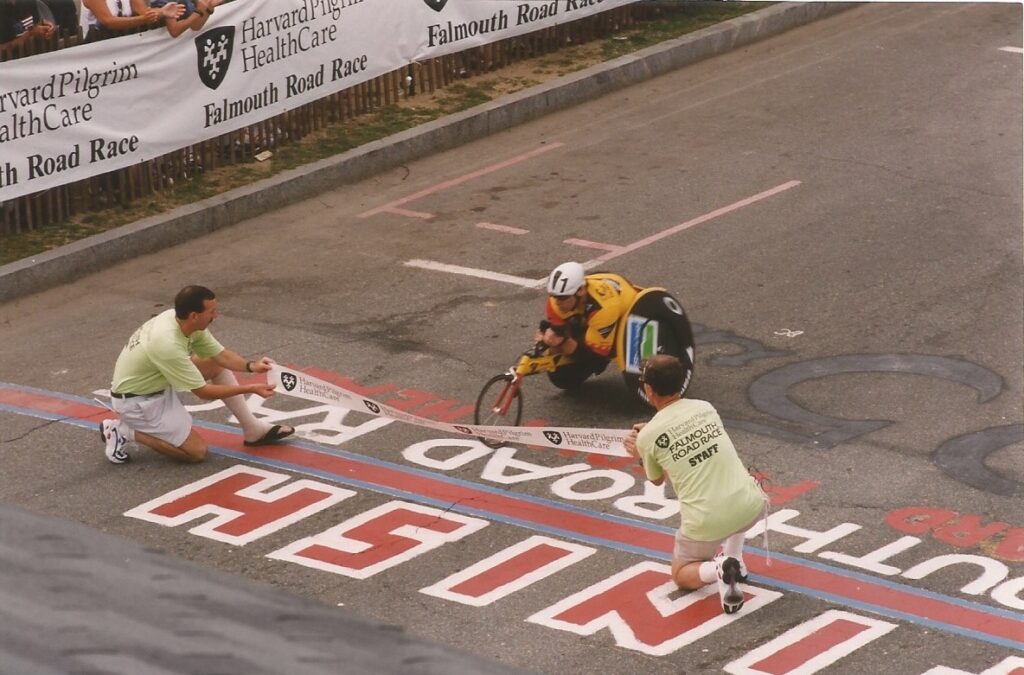
Photo: Craig Blanchette crossing the finish line for one of his eight wins
Inquisitive and creative, Raymond was driven by boundless curiosity, loved tinkering, figuring out how things worked and imagining ways to make them work better. Hall was motivated by trying to make his chair go faster. Together, they worked in Falmouth on a more efficient, sleek design. In 1978 a new company, Hall’s Wheels, rolled out the first racing wheelchair. The sport was changed forever.
The chairs were custom-made to fit each athlete and weighed only about 16 pounds, compared to the bulky 40-plus pound wheelchairs from the early years at Falmouth.
Not only was Hall a decorated champion, he mentored future racers who went on to do great things, including Louis Antonio of Peabody, who had four podium finishes in Falmouth, including a stretch from 1989-1994 when he was twice runner-up and two times third. The memorable ‘91 race featured Antonio and Blanchette in a sprint to the finish with Antonio second to Blanchette by just one second. They both destroyed the existing course record by over three minutes (25:47).
How significant was Hall’s impact to the sport? No less than MoMA – the Museum of Modern Art in New York City – included a Hall racing wheelchair in its 1989 exhibition on Designs for Independent Living. The innovative racing machine featured a lightweight frame of aircraft-steel tubing and wheels adapted from racing bicycles angled for optimal arm movement and enhanced speed.
Hall has been inducted into the National Wheelchair Athletic Association and the Move United Adaptive Sports Halls of Fame.
And all the athletes who followed Hall – many in Hall’s Wheels-designed chairs – are forever grateful for the path he paved. By 1977, two years after Hall was the solitary racer, the wheelchair division’s entries tripled as Paralympians from around the U.S. and the world were drawn to the scenic course and one of the top events on the calendar.
Falmouth’s rich history includes 18 different men’s champions and 15 different women’s champions. Marty Ball won in 1983, ending Hall’s dominance; New Englanders Paul Phelan and Rose Winand of Massachusetts raced into the winner’s circle; Tom Foran and Ann Walters from Connecticut also stood atop the podium as champions.
Prize money was awarded for the first time in the mid-1980s. The 2025 purse will include $5,000 each to the men’s and women’s winners.
In 1979 Natalie Bacon arrived and made her own mark on race history. A Paralympic swimmer, Bacon displayed her versatility by becoming Falmouth’s first women’s wheelchair champion. She would equal Hall with eight consecutive titles.
The wheelchair division has produced many dominant performances. Along with Hall, Blanchette won eight men’s titles in a remarkable span from 1995 to 2010. Daniel Romanchuk, who holds the course record (21:23 in 2023), has won five times, along with Krige Schabort and Tony Nogueira. The late Jim Knaub, Hall’s friend, training partner and fellow competitor, won three, which included a course record in 1989 (27:34).
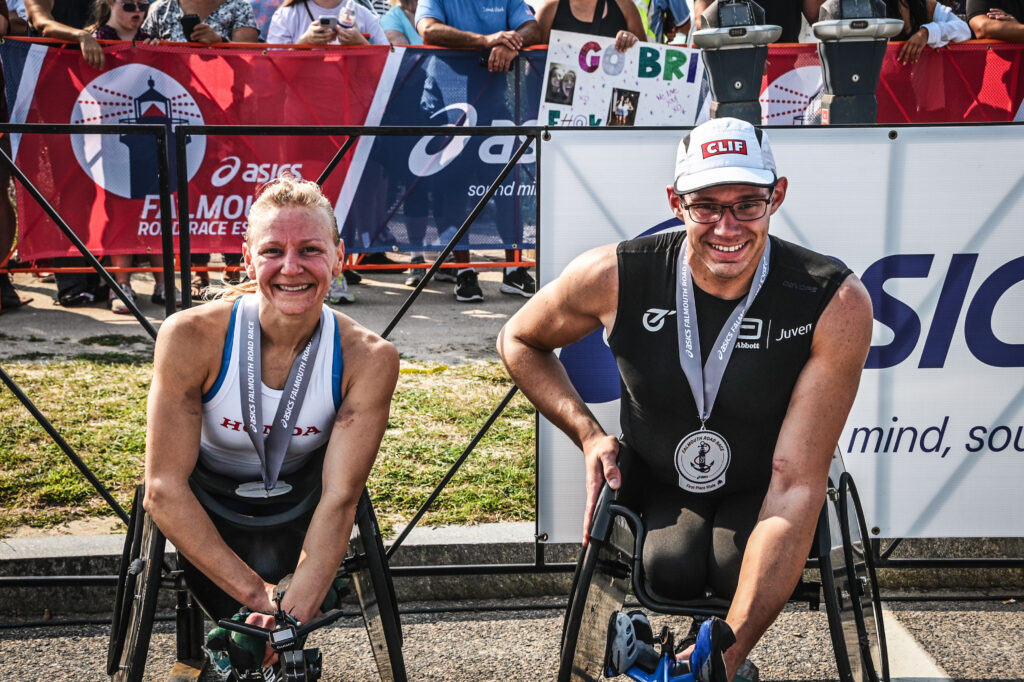
2023 champions, Susannah Scaroni and Daniel Romanchuk, after their record-breaking performances
“I did my first Falmouth Road Race in 2013 and what sticks out in my mind is the beautiful setting. It’s an amazing place to have a race,” said Romanchuk.
On the women’s side, Jessica Galli and Candace Cable are six-time champions; Ann Walters and Tatayana McFadden have each won five.
“I can’t think of road racing in my entire 27-year career as an athlete without thinking about Falmouth,” said Cable, a dominant competitor in the 1990s. She held the course record for an incredible 23 years, from 1991 until McFadden broke it in 2014. Susannah Scaroni set the new standard of 24:38 in her 2023 victory.
“From start to finish, the organizing committee saw great value (in us),” said Cable. “I instantly felt embraced and acknowledged and supported by the entire community. There was this real equity with the runners. I have great gratitude for everyone.”
McFadden, who will be in this year’s field, is one of the most decorated U.S. Paralympians ever, with 22 medals in both Summer and Winter Games.
“I have been coming to this race since 2014 (her first win) and my favorite part is racing along the ocean view,” she said. “You don’t get that very often in road racing. Falmouth holds a special place in my heart. It’s where my grandparents met and ever since we’ve had great family memories.”
McFadden has also served as a mentor and an inspiration to young Maddie Wilson, who she befriended at Falmouth. Wilson was only seven when she first completed the race in 2016. In 2019, when McFadden won for the fifth time, 10-year-old Wilson was an impressive fifth. Now 16, Wilson will be racing again this year.
Like many in the sport, McFadden is happy to pay it forward.
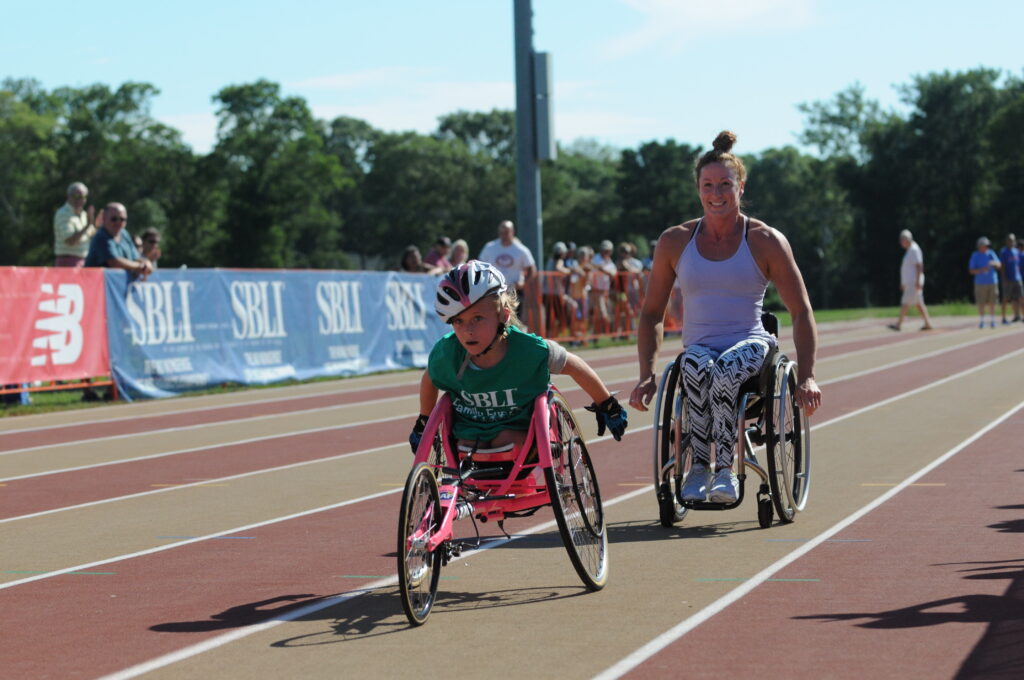
Tayanna McFadden trailing behind a young Maddie Wilson at the SBLI Family Fun Run
“(Maddie) really reminded me of my younger self,” she told the Boston Globe at the 2025 Boston Marathon. “I want to see the future generation grow. We’re going to be hosting the 2028 LA (Paralympic and Olympic) Games, and more than likely, she could be there.”
McFadden also appreciates the contributions Hall made at the infancy of the sport.
“(Bob) shattered barriers and paved the way for generations of athletes,” McFadden wrote in a Facebook post earlier this year. (He) demonstrated that wheelchair racing belonged … a statement that challenged prevailing attitudes and prejudices, inspiring countless others to believe that they too could compete at the highest level. His courage and determination laid the groundwork for the inclusive and competitive wheelchair division we see today. His contribution to the world of wheelchair racing is immeasurable.”
For his part, Hall’s message for today’s competitors is to enjoy the moment.
“When I started, I was in my 20s. Now we’re seeing kids in their early teens, if not even younger,” he said. “I hope they have the same positive experience that I have had.”
Hall’s legacy as a pioneer in the sport – and Falmouth’s as well – is assured.
“I want to be remembered. Times come and go. People come and go,” said Hall, forever in a league of his own. “But I hope whatever I’ve done lasts forever.”
Bill Higgins is the retired sports editor of the Cape Cod Times. He has written about the Falmouth Road Race every year since 1975 and has run the race about a dozen times. He can be reached at bhiggins54@gmail.com
Donna Tocci is a communications professional and passionate advocate for adaptive athletes. She has been a 30-year volunteer for the road race and a member of the Falmouth Road Race, Inc. board of directors. She can be reached at dmtocci@gmail.com